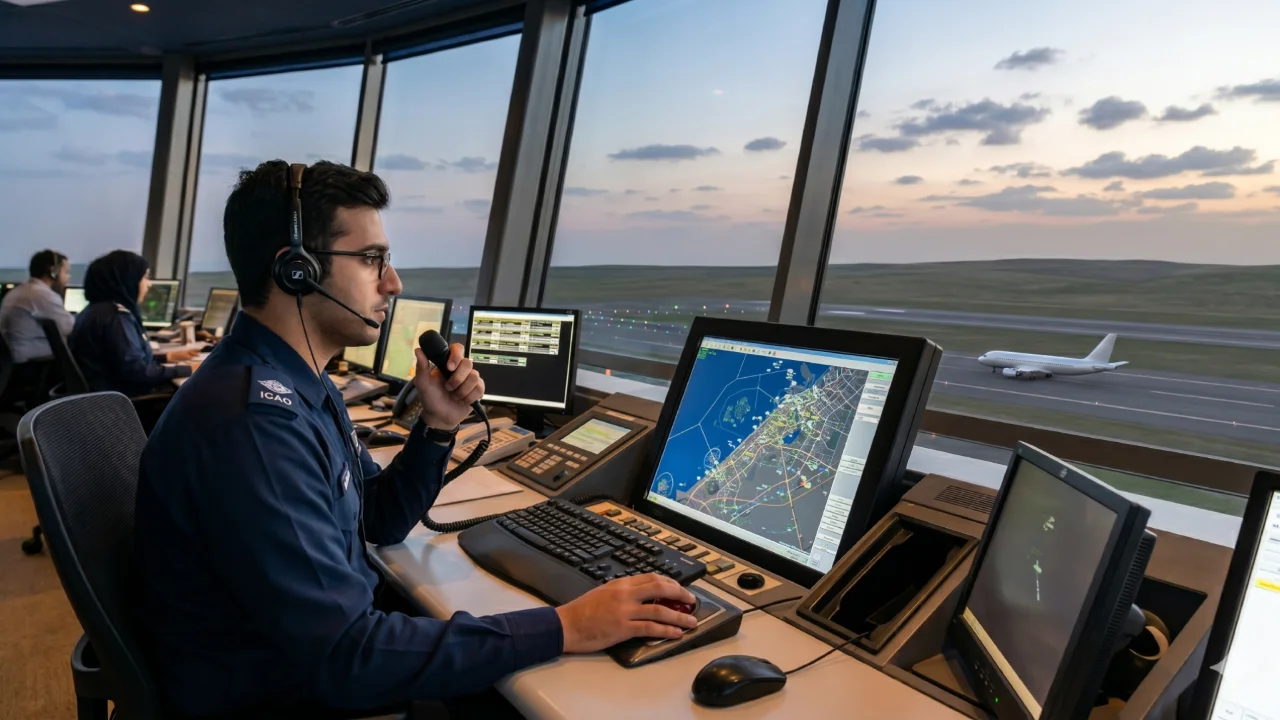
Every aircraft you see climbing above Dubai International Airport is being watched. There is a controller behind a radar screen, a headset pressed to their ear, making split-second decisions that keep hundreds of lives safe. That controller's journey almost certainly began with a single, defining course — the ICAO ATC 051.
If you have ever looked up at the sky and wondered whether you have what it takes to be the voice in the tower, this article is written for you. The ICAO ATC 051 Course in Dubai is not simply a training programme. It is the mandatory foundation upon which every professional air traffic controller in the UAE, and across the globe, builds their entire career.
The Gateway to Air Traffic Control: The ICAO ATC 051 Framework
The ICAO ATC 051 — formally known as the Basic Air Traffic Control Induction Course — is the internationally standardised entry point into the air traffic services (ATS) profession. Delivered over an intensive 8-week programme totalling 320 hours of structured instruction, it takes ab-initio candidates from zero professional knowledge to a clearly defined level of operational readiness recognised across all 193 member states of the International Civil Aviation Organization.
The course is designed around one core principle: expose the student to the full scope of the professional aviation environment before they ever set foot on a live unit. This means the syllabus does not skim the surface. It demands academic rigour, spatial reasoning, communications discipline, and the ability to perform under pressure from the very first week.
At ATW Aviation Training Services — a fully GCAA and DCAA-approved training organisation based in Nad Al Hammar, Dubai — the ATC 051 programme is delivered in strict compliance with ICAO Annex 1 personnel licensing standards. Annex 1 sets the international benchmark for the knowledge, skill, and experience requirements that every licensed controller must demonstrate before assuming operational responsibilities. By anchoring its curriculum to these standards, ATW ensures that every graduate enters the workforce with credentials that are globally portable and locally authoritative.
This matters enormously in the UAE, where the General Civil Aviation Authority (GCAA) governs the licensing of all aviation personnel. A GCAA-approved ATC qualification is not a regional nicety — it is a legal prerequisite for employment within the UAE Flight Information Region (FIR). Enrolling in a programme that is not GCAA-sanctioned is the same as not enrolling at all. You can read more about why this distinction is so critical in ATW's dedicated guide on understanding GCAA and DCAA approvals for aviation training.
Core Theoretical Modules of the GCAA-Aligned ATC Syllabus
The 320 hours of instruction within the ATC 051 framework are not distributed arbitrarily. The academic breakdown has been constructed to mirror the sequence of knowledge a working controller applies every single shift — from the legal framework governing the airspace above them, to the weather conditions that will dictate the flow of traffic below.
Students learn to read an aviation environment holistically. That means understanding not only how to issue a clearance, but why that clearance is the correct one given the aircraft performance characteristics, the prevailing weather, the applicable procedures, and the separation minima mandated by ICAO Doc 4444. From day one, the course trains candidates to coordinate aircraft movements in three dimensions while simultaneously preventing separation conflicts — the type of thinking that cannot be improvised on a live radar screen and must be internalised through structured, methodical instruction.
The theoretical component of the programme is also where students begin to understand the sheer interconnectedness of aviation. A meteorological condition does not exist in isolation — it influences routing decisions, which in turn affect sequencing, which then places demands on the controller's workload management. Understanding these relationships at an academic level is precisely what separates a trained air traffic services professional from someone simply following procedures.
For a broader view of what the daily responsibilities of a qualified controller look like once this training is complete, ATW's blog post on a day in the life of an air traffic controller in the world's busiest airspace offers a compelling and honest perspective.
Navigation, Meteorology, and Aircraft Performance
Two of the most technically demanding modules within the ICAO ATC 051 syllabus are Meteorology and Navigation — and for good reason. They represent the physical environment in which every controller operates, and misreading either can have catastrophic consequences.
Meteorology: Reading the Sky Before the Pilot Does
The meteorology module teaches students to decode and apply real-world aviation weather products. METAR reports — the standardised hourly weather observations issued from certified aerodrome stations — become a working language. TAF forecasts, SIGMET advisories, and wind shear alerts are not abstract academic exercises; they are the tools a controller uses to anticipate delays, reroute traffic, and communicate critical information to flight crews before they encounter hazardous conditions.
Students learn how cloud formations, visibility restrictions, and wind direction changes translate into operational decisions at the approach and aerodrome control level. By the time they complete this module, reading a METAR is as natural as reading a message on their phone.
Navigation and Performance-Based Navigation (PBN)
Navigation within the ATC 051 curriculum extends well beyond basic map reading. Students develop a working understanding of Performance-Based Navigation (PBN) — the modern framework that defines how aircraft navigate using on-board systems rather than ground-based radio beacons. This matters for controllers because PBN procedures define the protected airspace corridors along which aircraft must be kept, and any deviation from those corridors demands an immediate and precise response.
The module also covers aircraft service ceilings, climb and descent profiles, and the performance variances between different aircraft categories — from narrow-body jets to wide-body freighters — so that controllers can issue realistic and operationally sound instructions that aircraft are actually capable of executing.
Aviation Law and Airspace Structures under UAE Rules
No component of the ATC 051 programme is more consequential to long-term professional competence than the Aviation Law module. This is where students gain their foundational understanding of the legal framework within which every controller operates.
UAE Airspace Classifications: Class A through G
The UAE Flight Information Region (FIR) encompasses one of the most complex airspace structures in the world, handling some of the highest traffic densities on the planet. The ATC 051 curriculum teaches students to navigate the full spectrum of ICAO airspace classifications — Class A through Class G — understanding the rules of access, the separation requirements, and the communications obligations that apply at each level.
Class A airspace, which governs the upper-level controlled routes, demands the highest levels of separation and clearance authority. Class G, at the lower end, is uncontrolled but still demands situational awareness. Understanding where one classification ends and another begins — and what changes in terms of controller responsibility at each boundary — is a non-negotiable competency for anyone entering the profession.
GCAA CAR Part II Licensing Obligations
The GCAA Civil Aviation Regulations (CARs) Part II define the licensing requirements that govern all air traffic control personnel operating within the UAE. The ATC 051 module introduces students to these obligations from the outset — covering the conditions for issuing student controller licences, the medical fitness requirements, the English language proficiency standards mandated by ICAO, and the pathways to obtaining rating endorsements upon completion of unit training.
This is not merely academic. Understanding the regulatory obligations that will govern your career from its first day is a mark of professional maturity, and ATW builds this understanding into the curriculum deliberately. The relationship between GCAA and ICAO frameworks is further explored in ATW's detailed comparison of GCAA vs EASA aviation licences — essential reading for anyone planning a UAE-based aviation career.
The Power of Simulation: From Classroom to 3D Tower Drills
Theoretical knowledge, no matter how deep, cannot replicate the experience of actively managing live traffic. This is the fundamental challenge of all ATC training — and it is the problem that simulation technology was built to solve.
25 Evaluated Exercises on 3D Tower Simulators
The practical component of the ATW ATC 051 programme includes 25 individually evaluated exercises conducted within a state-of-the-art 3D tower simulator environment. These are not passive observation sessions. Each exercise places the student in the controller's seat, responsible for active traffic separation, clearance issuance, and real-time decision-making — with performance assessed against defined competency standards.
The 3D tower simulator at ATW replicates actual aerodrome environments with high-fidelity visual accuracy. Students conduct crossing runway drills, manage simultaneous departures and arrivals, and practice emergency traffic handling — all within a safe, controlled environment where mistakes become learning experiences rather than incidents. ATW's dedicated blog post on why 3D tower training is non-negotiable and how 3D simulators bridge the gap in ATC training expand on this methodology in significant depth.
Generic and Site-Specific Aerodrome Modelling
One of the most important features of advanced ATC simulation is the distinction between generic aerodrome models and site-specific reproductions. Generic models are essential for teaching foundational skills — how to manage a standard runway layout, how to sequence traffic at a simple aerodrome. Site-specific models, however, introduce the additional cognitive complexity of a real airport's unique geometry: intersecting taxiways, multiple runways, apron configurations, and ground movement control requirements.
ATW's simulator programme uses both model types in deliberate sequence, ensuring that students do not develop what instructors call "simisms" — habits and assumptions formed in the simulator that have no basis in real-world operations. This disciplined approach to simulation design is a direct reflection of ATW's commitment to producing controllers who are operationally ready, not just academically competent. This ethos connects directly to ATW's broader approach to air traffic control foundations through air law.
From Theoretical Vectors to Real-Time Radar Separation
The final phase of the simulation curriculum bridges the critical transition from theoretical vectoring exercises to real-time radar separation. Students who have absorbed the academic content of the programme begin applying it in live simulator scenarios — issuing radar headings, altitude assignments, and speed controls to replicate aircraft, managing the geometry of the traffic picture as it evolves second by second.
This transition is where the depth of the theoretical training reveals its value. Students who have genuinely internalised the navigation, meteorology, and aviation law modules approach the radar screen with confidence. Those who have not find the cognitive load overwhelming. ATW's instructional model is designed to ensure every student arrives at the simulator fully prepared.
Securing Your Path in UAE Air Traffic Services
The ICAO ATC 051 course is not the end of the journey — it is the beginning. Completion of the programme provides the mandatory theoretical and practical baseline required before a candidate can commence unit training and work toward their first rating endorsement: Aerodrome Control, Approach Control, or Area Control.
Career Entry as an ATS Assistant
For many graduates, the immediate career outcome is a role as an Air Traffic Services (ATS) Assistant — a structured entry point that allows newly qualified individuals to gain on-the-job experience within a live ATC environment under the supervision of a licensed controller. This role acts as the bridge between the controlled learning environment of the training programme and the full operational responsibilities of a licensed ATCO.
The demand for qualified ATS professionals in the UAE has never been stronger. With Dubai International Airport consistently ranked among the world's busiest international hubs, and Al Maktoum International Airport expanding rapidly, the UAE's appetite for skilled air traffic services personnel is a long-term structural reality, not a short-term trend. More on the scope of available career pathways can be found in ATW's post on the highest-paying aviation careers in Dubai.
The Location Advantage: Nad Al Hammar, Dubai
ATW Aviation Training Services is based in Nad Al Hammar, Dubai — a strategically central location that places students within the heart of the UAE's operational aviation ecosystem. Training here means studying in the same city as the world-class operations students aspire to join, with all the networking, mentorship, and career exposure that proximity provides.
For UAE nationals, ATW's programme also aligns with Emiratisation initiatives in the aviation sector, supporting the national mandate to develop homegrown aviation talent. The GCAA's National ATC Training Programme provides an additional pathway for qualifying nationals, and ATW's blog on the GCAA national ATC programme covers these opportunities in full.
Entry Prerequisites and GCAA Medical Requirements
Candidates considering the ATC 051 programme should be aware of the entry prerequisites. The GCAA mandates that candidates satisfy age requirements and hold a GCAA Class 3 medical certificate as a prerequisite for ultimate licensing. Aviation English proficiency at a minimum of ICAO Level 4 is also a mandatory licensing requirement — a standard that ATW's dedicated Aviation English course is specifically designed to help students achieve. The relationship between English proficiency and ATC career progression is explored further in ATW's post on why aviation English is the biggest hurdle for ATC students.
The ATC 051 course also lays the groundwork for the FEAST — the Foundation Exam for Air Traffic Services — which some regional and international organisations require as part of their recruitment process. By completing ATW's programme, candidates are not simply earning a certificate. They are building the demonstrable competency profile that the best employers in UAE aviation look for.
Take the First Step into UAE Aviation
The skies above Dubai do not manage themselves. Behind every smooth departure, every sequenced approach, and every safely resolved traffic conflict is a controller who chose to invest in the right training at the start of their career.
The ICAO ATC 051 Course at ATW Aviation Training Services gives you exactly that foundation — GCAA-approved, ICAO-aligned, simulator-intensive, and delivered by instructors who understand both the academic demands of the syllabus and the real-world environment you are training to enter.
If you are ready to begin building a career that matters, explore the full range of GCAA-approved aviation courses at ATW Aviation and secure your place on the next intake today.
ATW Aviation Training Services | GCAA & DCAA Approved | Nad Al Hammar, Dubai Contact ATW Aviation | View All Courses