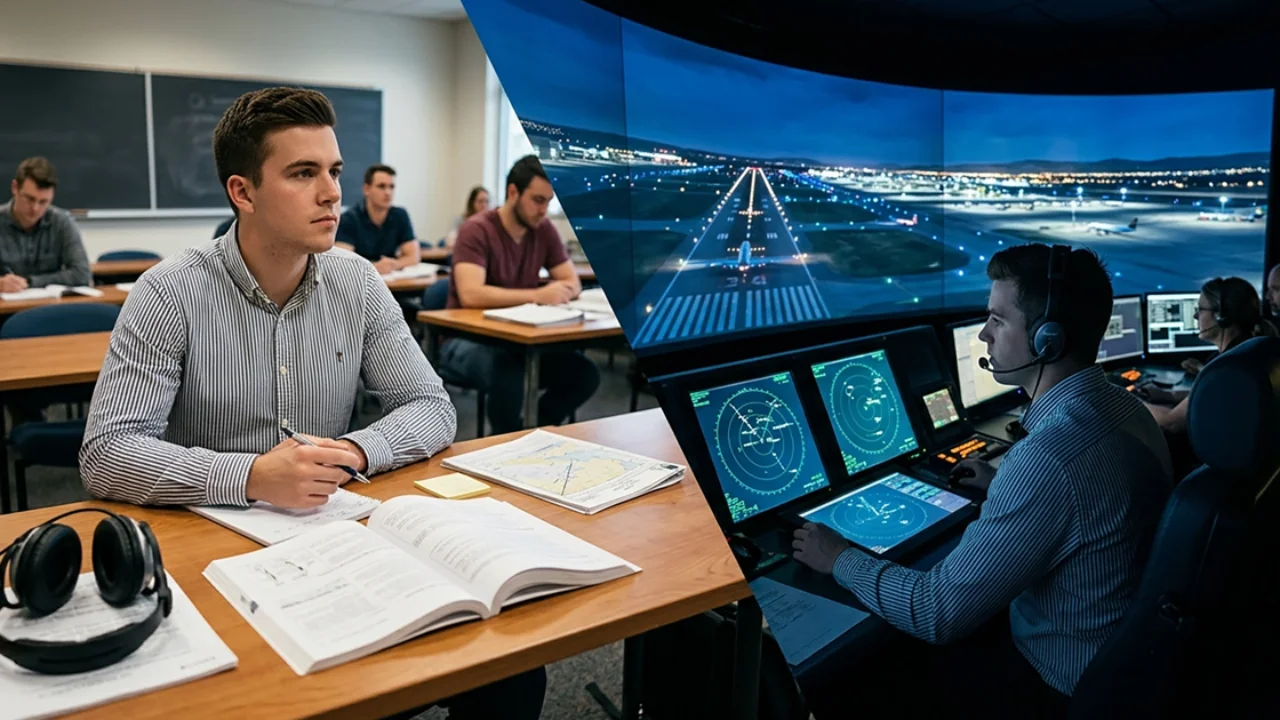
There is a moment every trainee air traffic controller remembers — the first time the simulator comes alive around you. Aircraft call signs flood the frequency. A departing aircraft is climbing through the level of an arrival. A pilot reads back the wrong instruction. And you have to respond. Correctly. Right now.
That moment is the whole point.
No classroom textbook, no matter how detailed, can fully replicate the controlled pressure of managing real traffic. But a high-fidelity 3D tower simulator can come remarkably close — and in the context of ICAO ATC 051 training, it is not a luxury. It is a regulatory requirement.
For tech-savvy school leavers who have grown up on immersive games and virtual environments, the simulation suite is the most exciting part of modern ATC training. But it is far more than impressive technology — it is the bridge between knowing the rules and being able to apply them under real-world pressure.
The Physics of Flight in a Virtual World
Walk into a modern ATC simulator suite and you are not walking into a classroom — you are walking onto an operations floor. Wraparound screens recreate panoramic views of airports and approach corridors with near-photographic accuracy. Traffic flows at realistic densities. Weather systems develop in real time. Radar returns, strips, and communication frequencies all respond to your inputs exactly as they would in a live operational environment.
The visual fidelity is the first thing that strikes trainees, but it is the physics engine underneath that matters most. Aircraft in a high-quality simulator do not simply move from point A to point B. They accelerate and decelerate according to their performance characteristics, respond to wind and temperature, and generate realistic radar returns that reflect what a controller would actually see on a scope.
This level of authenticity is critical. ICAO standards for ATC training require that practical exercises replicate operational conditions faithfully enough to build genuine competence — not just familiarity with the concept of managing traffic. The gap between watching a demonstration and actually working the position is enormous, and 3D simulation is what closes it.
For a student who has been studying aviation air law, separation standards, and phraseology in the classroom, the simulator is where those abstract rules become instinct. You do not just know that two aircraft need 1,000 feet of vertical separation — you feel the urgency of issuing the correct clearance in time to achieve it.
Why 10 Days of Practical Training is the Core of ICAO 051
The ICAO ATC 051 Basic Induction Course approved by the GCAA is structured around a specific, non-negotiable requirement: 10 days of dedicated practical simulator training. This is not an add-on to the academic content. It is the centrepiece of the entire programme.
Those 10 days are structured progressively. Early sessions are designed to build familiarity — students learn how the position works, how to communicate with pilots using correct ICAO radiotelephony phraseology, and how to read the radar picture. Traffic scenarios are manageable, and instructors are present to observe without pressure.
As the programme advances, scenario complexity increases deliberately. Traffic density builds. Weather deteriorates. Aircraft develop faults. And crucially, the On-the-Job Training Instructor — the OJTI — steps back.
The OJTI's role in the simulation environment is central to how competence is assessed and developed. In a live operational environment, the OJTI would be seated beside a trainee controller, authorised to intervene if safety were at risk. In the simulator, they play the same role — observing, coaching, and debriefing — but with the critical advantage that any scenario can be paused, rewound, or re-run. A mistake in the simulator is a teaching moment. The same mistake in live airspace could be an incident.
This progressive structure — moving from guided practice to independent performance under OJTI oversight — is what transforms a student into a candidate ready for the next phase of their ATC pathway. It is also what makes the practical component so much more valuable than additional classroom hours. Understanding a concept and demonstrating competence are two entirely different things.
Simulating Emergencies: Preparing for the Unpredictable
Real aviation does not wait for convenient moments to present its challenges. Hydraulic failures happen in the middle of busy departure sequences. Pilot incapacitation can occur on approach to a runway already occupied by a taxiing aircraft. A runway incursion alert may activate precisely when a controller is coordinating a holding stack.
This is where the simulator earns its place in ICAO-compliant training most convincingly.
Emergency scenarios — those that would be impossibly dangerous to rehearse in a live environment — can be run repeatedly in simulation until trainees develop the procedural memory to handle them. ICAO Doc 9432 outlines specific phraseology for emergency handling, and practising those calls in a simulated environment, with a real radio setup and live-pressure timing, is fundamentally different from reciting them in a classroom.
The psychological dimension matters too. Aviation emergencies trigger stress responses that can degrade cognitive performance precisely when clarity is most needed. A trainee who has managed simulated emergencies under realistic conditions — elevated heart rate, time pressure, competing priorities — is neurologically better prepared than one who has only studied the procedures. The simulator trains the mind as well as the procedure.
Scenarios used in ATW Aviation's ICAO 051 programme include runway incursions, aircraft declaring Mayday or Pan-Pan, communications failures, and simultaneous multi-aircraft conflicts. Each scenario is debriefed by the OJTI with structured feedback — not just what went wrong, but why, and what cognitive processes led to the error.
If you want to understand how these human performance factors connect to day-to-day safety, the post on ATC Safety: Mastering Human Performance and Fatigue Management in Dubai's Airspace explores this dimension in depth.
Why Global Hubs Trust Simulator-Trained Graduates
Dubai International Airport handles over 87 million passengers a year, operates from two major runways, and processes some of the most complex traffic flows in the world — long-haul wide-bodies mixing with regional jets, cargo freighters, private aviation, and increasingly, unmanned aerial systems. The operational tempo is relentless, and the margin for error is, correspondingly, extremely narrow.
ANSPs — Air Navigation Service Providers — responsible for hiring and training controllers for environments like Dubai do not take onboarding risk lightly. They want candidates who arrive with demonstrable practical skills, not just academic knowledge. Simulator-trained graduates from GCAA- and DCAA-approved training programmes arrive at unit training with the cognitive frameworks already in place.
The logic is straightforward. A student who has already worked through high-density traffic in simulation — who has felt the demand of managing four aircraft simultaneously with competing priorities — adapts to unit-level on-the-job training faster, and with fewer errors in the critical early weeks. This is not anecdotal. It reflects the design intent of ICAO's training standards, which explicitly recognise simulation as the most effective bridge between initial training and operational performance.
SKYbrary — the aviation safety knowledge platform developed by ICAO, EUROCONTROL, and the Flight Safety Foundation — extensively documents the evidence base for simulation-based training in ATC. The data consistently shows that trainees with high-quality simulator exposure demonstrate better situational awareness, more effective communication, and lower error rates during initial on-the-job training.
For anyone considering a career in aviation who wants to understand the full trajectory, the post on A Day in the Life of an Air Traffic Controller in the World's Busiest Airspace paints a vivid picture of what that career looks like in practice.
And if you are still building the language skills needed to succeed in an English-medium ATC environment, the Aviation English Communication course at ATW Aviation is designed as the essential pre-requisite — because precise language under pressure is what the simulator, and the tower, ultimately demand. For a deeper look at that challenge, the post on Why Aviation English is the Biggest Hurdle for ATC Students is essential reading.
See the Technology for Yourself
Reading about simulator training is one thing. Standing inside a 3D tower environment, headset on, traffic building on the scope, is something else entirely.
ATW Aviation invites prospective students and their families to book a facility tour and experience the ATC simulator suite in person. See where the ICAO ATC 051 Basic Induction Course comes to life. Speak to instructors. Understand exactly what those 10 practical training days look like — and why they are the most important investment you will make in your ATC career.