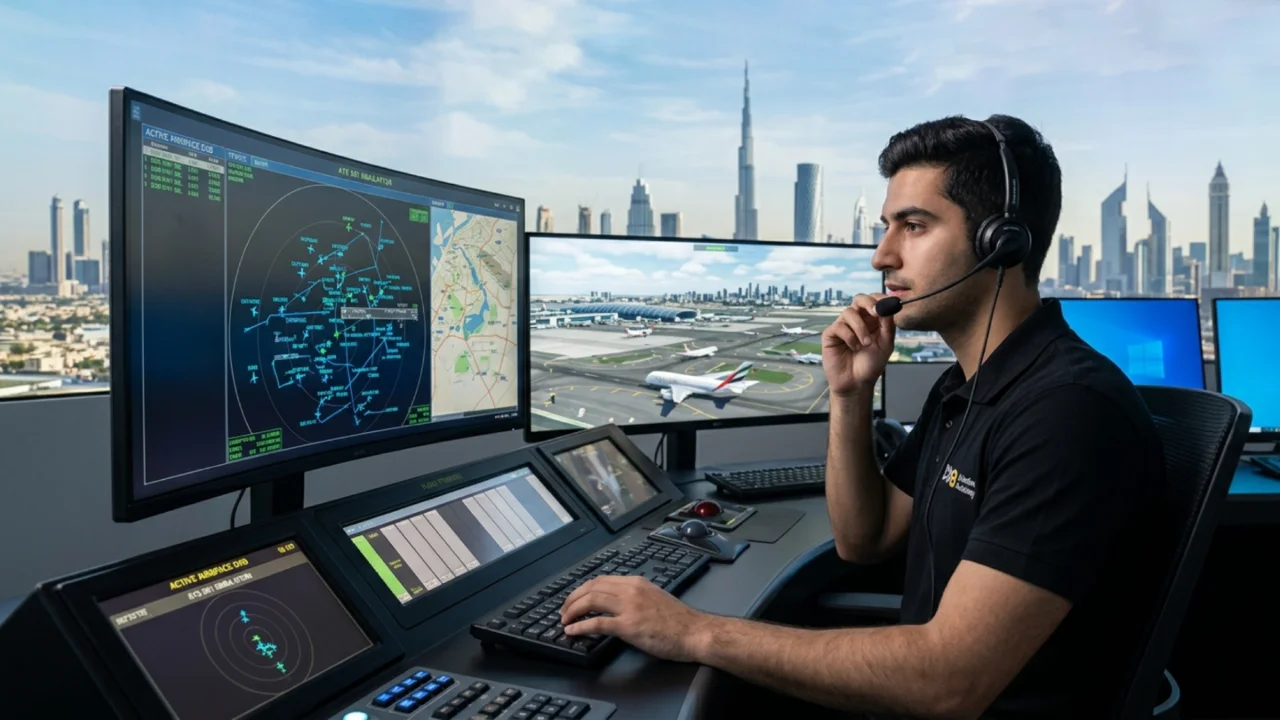
Every professional air traffic controller working the skies above Dubai, Abu Dhabi, or any international aerodrome began at precisely the same point — the ICAO 051 ATC course. There is no shortcut, no workaround, and no alternative. The ICAO 051 ATC course Dubai professionals and aspiring controllers pursue is the legally mandated, universally recognized entry point to the entire air traffic control profession. If you are serious about a career managing one of the world's most demanding and rewarding airspaces, understanding what this course demands — and where you train for it — is the most important research you will do.
UAE airspace recorded more than 1 million air traffic movements in 2024. Behind every single one of those movements was a trained, certified controller. The pipeline feeding that workforce starts here.
The Significance of ICAO 051 in the ATC Lifecycle
The number "051" is not arbitrary. Within the ICAO training framework, it designates the ab-initio phase — a Latin term meaning "from the beginning" — of the air traffic controller induction pathway. It is Part D-3 of ICAO Doc 7192, the authoritative document governing the training of Air Traffic Services personnel across all 193 ICAO member states.
Before a trainee can set foot in a live aerodrome control tower, before they can pursue an Aerodrome rating, an Approach rating, or an Area Control endorsement, they must complete the 051 induction. It is the mandatory prerequisite for all subsequent unit-specific training. No employer in the UAE — government, military, or commercial — will advance a controller candidate to On-the-Job Training (OJT) without a recognized 051 certificate in hand.
Think of it this way: a medical student cannot practice surgery on a patient before completing foundational anatomy. An aspiring controller cannot manage live traffic before completing the 051. The regulatory logic is the same, and the stakes are equally non-negotiable.
The curriculum itself is built on a clear philosophy: a controller who finds training harder than the job will be operationally ready for anything. Every subject, every simulation, every assessment is designed to test candidates at a level that mirrors — and deliberately exceeds — the pressure of real-world operations.
Core Technical Pillars: Air Law, Meteorology, and Navigation
The 051 curriculum is not a broad survey of aviation. It is a precisely engineered set of technical disciplines, each selected because operational controllers cannot function without mastery of them. The 3 foundational pillars are Air Law, Meteorology, and Navigation, and each demands serious academic engagement.
Air Law: The Operational Manual of the Sky
Aviation Law is the first discipline a student encounters — and often the one that surprises them with its depth. This is not an abstract legal study module. Air Law for controllers is the working rulebook: the Chicago Convention, ICAO Annexes, UAE Civil Aviation Regulations (CARs), and the legal obligations of every party operating within controlled airspace.
Controllers who misapply Air Law do not receive a warning; they create incidents. The module is designed to transition students from passive legal awareness to active, instinctive application. By the time a student completes this pillar, they understand exactly what authority they hold, what they are legally obligated to provide, and what the consequences of any deviation look like in a real airspace environment.
Meteorology: Weather as an Operational Variable
Aviation Meteorology at the 051 level is equally demanding. Controllers do not need to forecast weather — but they do need to read it, communicate it accurately, and integrate it instantly into traffic decisions.
Interpretation of METAR and TAF Codes
METAR (Meteorological Aerodrome Report) and TAF (Terminal Aerodrome Forecast) codes are the primary weather communication tools in ATC operations. Students learn to decode these alphanumeric sequences rapidly and accurately, translating raw data into actionable guidance for flight crews. A controller who hesitates on a METAR in low-visibility conditions is a controller who cannot do the job.
The module covers cloud types, wind shear phenomena, visibility minima, and the meteorological conditions that trigger specific separation procedures — creating controllers who are operationally weather-aware from their first day on the floor.
Navigation: Knowing the Sky You Control
Navigation training gives students the spatial intelligence to understand and manage the airspace they will eventually control. This includes airspace classification and structure, conventional navigation aids (VOR, NDB, ADF, DME), Instrument Landing Systems (ILS), and Performance-Based Navigation (PBN) — the modern standard that underpins RNAV and RNP operations in the UAE and globally.
Airspace Structure and VOR/ADF Phraseology
Controllers communicate navigation instructions using precise phraseology. The module drills students on the correct standard phraseology for VOR, ADF, and ILS procedures — because clarity in radio communication is not a courtesy, it is a safety requirement. Ambiguous instructions in controlled airspace have preceded some of the most serious incidents in aviation history.
Human Performance and Equipment Systems
The 051 curriculum does not train technicians. It trains professionals who understand that human performance is the most critical variable in air traffic management — and the most unpredictable.
Module 9 Human Factors is integrated into the 051 course at ATW Aviation, covering stress management, decision-making under pressure, and situational awareness. Students study the Swiss Cheese Model of accident causation — the landmark framework that explains how catastrophic failures occur not from a single error, but from multiple aligned deficiencies in a complex system. Understanding this model changes how a controller approaches every shift.
The equipment and systems component covers Secondary Surveillance Radar (SSR), radar theory, transponder operation, and the communication links that connect a controller to their traffic. Modern ATC relies on integrated digital systems, and 051 students need a firm theoretical grounding before they encounter live equipment during OJT.
Together, the Human Factors and Equipment Systems modules reinforce the 051 philosophy: training harder than the job, so that when reality arrives — busy traffic, degraded equipment, pilot non-compliance — the controller is prepared.
Why GCAA and DCAA Approval Matters for Your Career
This is a point that cannot be stated plainly enough: a certificate from a non-approved training organization is worthless for employment in the UAE aviation sector.
Airlines, Air Navigation Service Providers (ANSPs), and airport authorities operating under UAE jurisdiction are legally required to verify that any prospective controller holds certifications issued by a recognized Approved Training Organization (ATO). The General Civil Aviation Authority (GCAA) governs this approval at the federal level. The Dubai Civil Aviation Authority (DCAA) applies an additional layer of oversight for organizations operating specifically within Dubai.
ATW Aviation is both GCAA-approved and DCAA-approved — one of the few training organizations in the UAE holding both regulatory endorsements simultaneously. This dual approval is not a marketing claim; it is a legal credential that confirms every hour of training delivered at ATW meets GCAA standards and ICAO's internationally recognized Standards and Recommended Practices (SARPs).
Completing your 051 at ATW means your certificate carries weight with every employer in the UAE Flight Information Region (FIR) and is recognized in all 193 ICAO member states. Completing it elsewhere — at an organization without GCAA or DCAA endorsement — means starting again.
ATW's 8-week onsite intensive program delivers 240 hours of theoretical instruction, structured around the ICAO Doc 7192 Part D-3 syllabus. The program is delivered in Dubai, positioning students within one of the world's most active aviation ecosystems. ATW operates under the institutional support of the Mohammed Bin Rashid Foundation, reinforcing its commitment to developing UAE aviation talent at the highest professional standard.
Entry into the program requires candidates to demonstrate English proficiency at ICAO Level 4 or equivalent (IELTS 5.5). This is not an arbitrary threshold — it reflects the operational reality that controllers must communicate clearly and precisely in English with international flight crews from their first day on the job.
For a comprehensive breakdown of what GCAA and DCAA approval means for your training investment, read Understanding GCAA and DCAA Approvals for Aviation Training on the ATW blog.
From Classroom to Control Tower: What Completion Opens
Graduates of the ICAO ATC 051 course Dubai program are certified at the ATS Assistant level — one of the most sought-after entry-point roles in the UAE's aviation employment market. The ATS Assistant classification provides the legal and professional foundation to:
Proceed to On-the-Job Training (OJT) at a live aerodrome control tower
Pursue unit-specific rating endorsements: Aerodrome Control (ADC), Approach Control (APP), and Area Control (ACC)
Apply for roles with UAE Air Navigation Service Providers, airport operators, and aviation authorities
Build toward advanced ATC specializations in radar, oceanic, or procedural control
The demand is real and growing. Global forecasts project a requirement for more than 25,000 additional air traffic control personnel by the mid-2030s, with the Middle East absorbing a significant proportion of that demand as the region continues its trajectory as a global aviation hub.
The 051 is the start. Everything else depends on completing it properly, at a regulator-recognized institution, with a curriculum that prepares you for the real operational environment — not just an exam.
Take Your First Step Toward a Career in Air Traffic Control
ATW Aviation's GCAA-approved ICAO ATC 051 course is designed for ab-initio students — whether you are a UAE National pursuing an aviation career, a recent high school graduate exploring professional pathways, or an aspiring controller from anywhere in the world.
The 8-week program provides everything you need to enter the profession correctly: a rigorous ICAO-aligned curriculum, GCAA- and DCAA-approved certification, expert instructors with operational ATC experience, and the institutional backing of one of Dubai's most respected aviation training organizations.
Explore all available courses and enrollment details at ATW Aviation's course page, or contact the ATW team directly to discuss your eligibility and start date.
The airspace is waiting. Your training begins here.