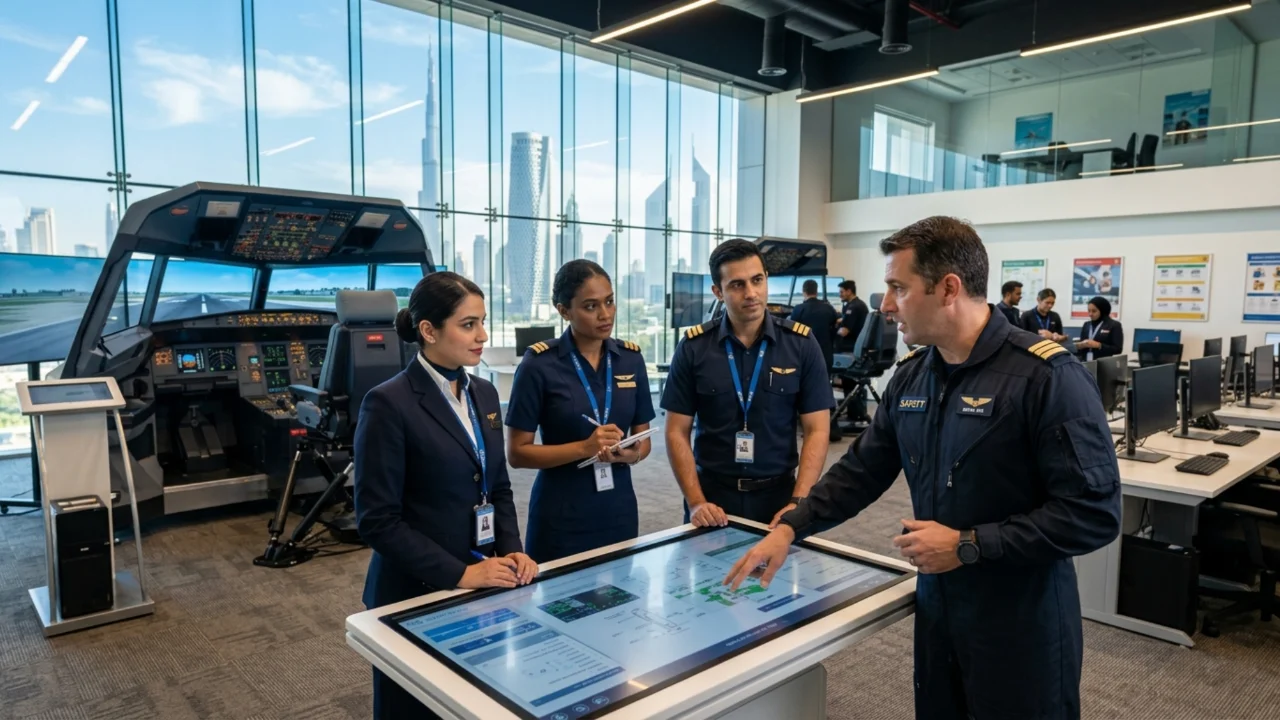
SMS Aviation Training: Implementing the Four Pillars of Safety in Dubai
Aviation does not get second chances. When a hazard goes undetected, when a risk control fails silently, or when a safety report sits unread in an inbox, the consequences can be catastrophic. That is precisely why the Safety Management System (SMS) is not a box-ticking exercise — it is the operational backbone of every GCAA-approved aviation organisation in the UAE.
For Safety Officers, Accountable Managers, and Quality Auditors working within the UAE's fast-expanding aviation sector, mastering the Safety Management System SMS UAE framework is both a legal obligation and a direct investment in organisational resilience. This post walks through the full SMS architecture — from its international legal foundation in ICAO Annex 19 to the practical GCAA CAR-Part X requirements your organisation must meet today.
The Mandate for Safety: Understanding ICAO Annex 19
Until 2013, aviation safety provisions were scattered across 14 separate ICAO Annexes. Annex 19 changed everything. For the first time, ICAO consolidated all safety management provisions into a single, unified global standard — one designed to make safety the core objective of every aviation service provider, not an afterthought.
The purpose of an SMS under ICAO Annex 19 is precise: ensure safe operations while simultaneously improving efficiency. These goals are not in conflict. When hazards are identified early and risk controls are verified to work, organisations operate more predictably, reduce incident costs, and protect their operating licences. Safety, properly implemented, is good business.
Annex 19 applies broadly. Flight training organisations, air navigation service providers (ANSPs), maintenance organisations, and aerodrome operators are all required to operate a functioning SMS. Amendment 2 to Annex 19, effective November 2026, will further extend SMS applicability to RPAS and drone operators — meaning organisations investing in SMS capability today are building a framework that will serve them for the next generation of aviation operations.
The UAE aviation sector contributes 18.2% to national GDP. That single statistic explains why both the GCAA and the DCAA treat systematic safety management as a national economic priority, not merely a regulatory formality.
The Four Pillars of a GCAA-Approved SMS
Every GCAA-compliant SMS is built on 4 interlocking pillars. Weakness in any 1 of them compromises the entire system. ATW Aviation's 2-day SMS course is structured around these pillars, giving participants the tools to build, audit, and continuously improve their organisation's safety framework.
Pillar 1: Safety Policy and Objectives
The Safety Policy is management's formal commitment to safe operations — and the Accountable Manager's signature on that document carries real legal weight under UAE federal law. The policy must define safety accountabilities, establish measurable safety objectives, and communicate management's commitment to adequate human and financial resources for safety activities.
This pillar is foundational. Without a clear policy, the remaining 3 pillars have no authority to draw on. Safety performance indicators (SPIs) must be defined at this stage, formally promulgated across the organisation, and monitored for trends over time.
Pillar 2: Safety Risk Management
This is where the SMS becomes operational. Hazard identification in UAE aviation uses 3 complementary methods:
Reactive — analysing incidents and accidents that have already occurred
Proactive — identifying hazards in current operations before they cause harm
Predictive — using data trends and operational modelling to anticipate future failure modes
Once hazards are identified, each is assessed for likelihood and severity. The resulting risk rating determines what mitigation action is required. Critically, risk controls must be documented, assigned to responsible individuals, and tracked to closure. A risk that is identified but never mitigated is worse than useless — it creates a false sense of security.
Pillar 3: Safety Assurance
Identifying hazards and implementing controls is only half the job. Safety Assurance answers the harder question: are the controls actually working?
This pillar covers safety performance monitoring, internal safety audits, and management of change — the process by which organisations formally assess the safety implications of any operational, structural, or procedural change before it is implemented. Organisations operating in Dubai's aviation environment, where fleet sizes and route networks expand rapidly, frequently underestimate the safety risks embedded in change. A robust assurance process catches those risks before they escalate.
Safety Assurance weighting in GCAA assessments is significant — 30% of the overall SMS evaluation — reflecting the regulator's view that verification of control effectiveness is at least as important as the controls themselves.
Pillar 4: Safety Promotion
The fourth pillar is often the most underestimated. Safety Promotion encompasses training, communication, and the deliberate cultivation of an open reporting culture across every level of the organisation.
The most dangerous environment in aviation is one where personnel fear the consequences of reporting errors. A Just Culture framework removes that fear. It draws a clear distinction between honest mistakes — which are handled through learning and system improvement — and wilful violations, which are handled through accountability. When people feel safe to report, the organisation gains access to the real data it needs to prevent accidents.
Compliance with GCAA CAR-Part X and ROSI
The Legal Framework
GCAA CAR-Part X is the UAE's federal regulatory instrument governing Safety Management Systems for approved aviation organisations. It mandates that every regulated service provider establish, implement, maintain, and continuously improve a documented SMS that is proportionate to the size and complexity of the organisation.
The Accountable Manager holds final authority — and final accountability — over both human resources and financial resources required for safe operations. This is not a delegable responsibility. The Accountable Manager must be able to demonstrate, to a GCAA inspector, that the SMS is functioning as designed and that safety objectives are being achieved.
When a condition of non-compliance is identified, organisations must define corrective action plans within 72 hours. This is a hard timeline, not a guideline.
The ROSI Mandatory Reporting System
The ROSI (Reporting of Safety Information) system is the GCAA's mandatory occurrence reporting platform. All regulated organisations must report qualifying safety occurrences through ROSI within the timeframes specified in CAR-Part X. Failure to report is itself a regulatory violation — separate from and in addition to whatever hazard triggered the reporting obligation.
ROSI is not a punitive tool. When used correctly, it is a national hazard intelligence system, aggregating occurrence data across the UAE's aviation network to identify systemic risks that no single operator could detect alone.
Managing the "Error Iceberg" and Unreported Events
Safety professionals recognise the "error iceberg" model: the accidents and serious incidents visible above the waterline represent only a small fraction of the total safety event load. Below the surface sit hundreds of near-misses, minor occurrences, and unsafe acts that go unreported — not because they didn't happen, but because the reporting culture failed.
ATW's SMS training addresses this directly, equipping participants with practical techniques for increasing voluntary reporting rates, analysing near-miss data, and using findings to strengthen risk controls before a serious event occurs.
SMS Documentation and Management of Change
A compliant SMS is a documented SMS. GCAA inspectors will ask to see the Safety Management System Manual, safety risk registers, SPI monitoring records, audit findings, and corrective action logs. Documentation is not bureaucracy — it is the evidence that your SMS is real, not theoretical.
Management of Change (MoC) procedures are particularly scrutinised. Any significant operational change — a new route, a facility upgrade, a restructured shift pattern, a technology transition — must pass through a formal safety assessment before implementation.
Creating an Implementation Plan for UAE Operators
Proportionality: The SMS Must Fit the Organisation
ICAO Annex 19 is explicit: the SMS must be commensurate with the size and complexity of the operation. A small approved training organisation and a major ANSP will have very different SMS architectures — and both are compliant if they meet the proportionality principle. Overcomplicated systems collapse under their own weight; underdeveloped systems miss hazards. ATW's training helps organisations calibrate the correct level of sophistication for their context.
The Accountable Manager's Role
The Accountable Manager is not merely a signatory. Under CAR-Part X, this individual must actively champion the SMS, ensure resources are available for safety activities, and participate in periodic safety reviews. Many UAE operators have capable safety teams whose efforts are undermined by an Accountable Manager who treats SMS as a compliance document rather than an operational tool. ATW's course is designed to change that perception — and to give Accountable Managers the language and frameworks they need to lead safety from the front.
What ATW's 2-Day SMS Course Delivers
ATW Aviation's Safety Management System course is built on ICAO Doc 9859 — the definitive Safety Management Manual — and aligned to GCAA CAR-Part X requirements. In 2 focused days, participants gain:
A working understanding of all 4 SMS pillars and how they interact
Practical hazard identification techniques using reactive, proactive, and predictive methods
Tools for establishing and monitoring Safety Performance Indicators (SPIs)
A framework for building a Just Culture and improving voluntary reporting rates
Guidance on ROSI obligations and CAR-Part X documentation requirements
Strategies for managing organisational change without compromising safety
For context on the regulatory environment your SMS must operate within, the ATW blog post Understanding GCAA and DCAA Approvals for Aviation Training explains how federal and Dubai-level oversight interact — knowledge that directly shapes how your SMS documentation should be structured.
ATW is both GCAA-approved and DCAA-approved, making it one of a select group of UAE training providers whose courses satisfy both the federal and Dubai-specific regulatory requirements simultaneously.
GCAA SMS Assessment Weighting
Understanding how the GCAA evaluates SMS maturity helps organisations allocate their development resources effectively.
SMS Component Assessment Weighting Core Focus Area Safety Policy and Objectives 20% Management commitment and resource allocation Safety Risk Management 30% Hazard identification and risk mitigation Safety Assurance 30% Verification that risk controls are effective Safety Promotion 20% Training programmes and open reporting culture
The 30% weighting applied to both Safety Risk Management and Safety Assurance reflects the GCAA's operational philosophy: identifying hazards matters, but verifying that the controls work matters just as much. Organisations that invest heavily in Pillar 2 while neglecting Pillar 3 are, in regulatory terms, only half-compliant.
For organisations that also need to develop their human performance frameworks alongside SMS — particularly in high-workload ATC environments — ATW's Human Factors course provides the complementary training that addresses the human side of the safety equation. The IATA Safety Management Implementation guide also provides supporting global context for organisations benchmarking their SMS against international best practice.
Build a Safety Culture That Outlasts Any Inspection
A mature SMS is not one that performs well during a GCAA audit. It is one that performs well every day, because the culture and the systems reinforce each other. Safety data flows freely. Hazards are caught early. Risk controls are tested, not assumed. The Accountable Manager leads by example, and frontline staff trust that reporting an error will improve the system rather than end a career.
That culture does not emerge by accident. It is built deliberately, through structured training, consistent leadership, and the disciplined application of a GCAA CAR SMS framework that is aligned with the global standard established in ICAO Annex 19.
The aviation sector in the UAE is growing faster than almost anywhere else on earth. The organisations that grow safely — and keep their operating licences and reputations intact — will be the ones that treat SMS as a management tool for performance, not a compliance document for inspectors.
Take the Next Step
Advance your organisation's safety culture and achieve full GCAA regulatory compliance by registering for the SMS course at ATW Aviation. Our GCAA and DCAA-approved 2-day programme gives Safety Officers, Accountable Managers, and Quality Auditors the practical frameworks they need to build, implement, and sustain a Safety Management System that meets federal law mandates — and genuinely protects the people and operations in your care.

 Translate