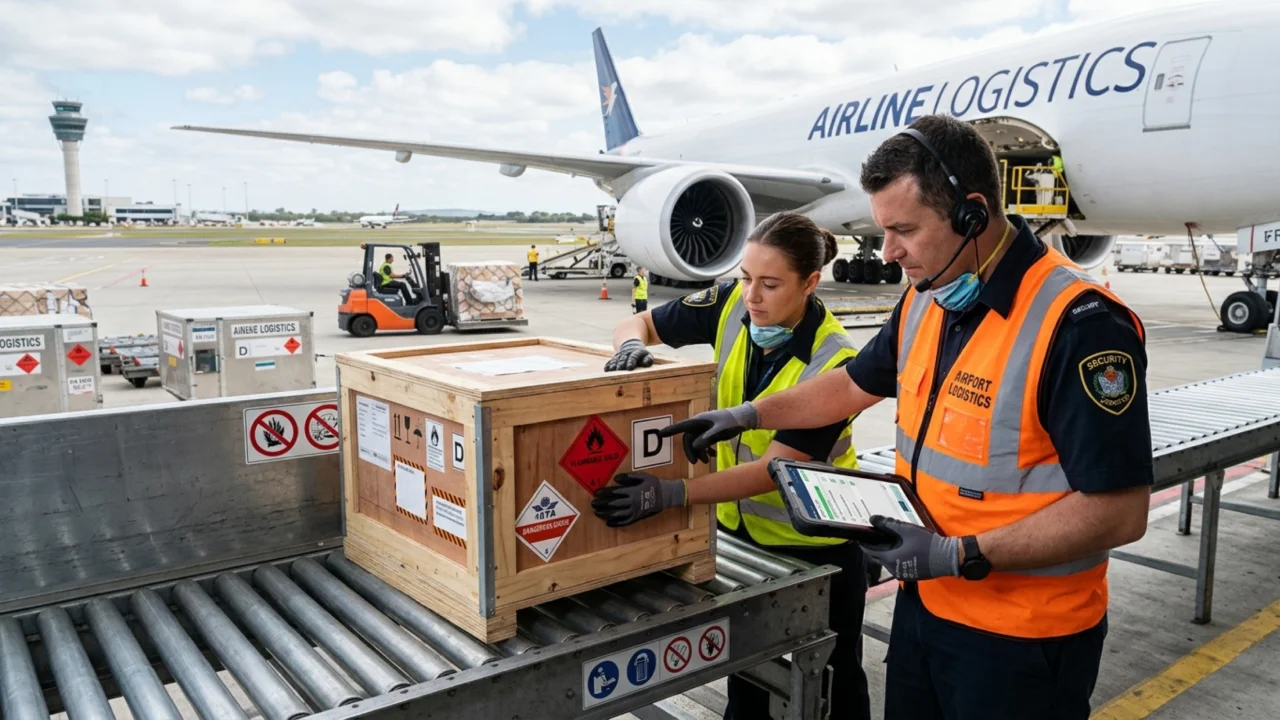
Every day, thousands of shipments pass through Dubai's cargo terminals — and a growing percentage of them contain Dangerous Goods (DGR). Lithium batteries. Flammable liquids. Radioactive materials. Infectious substances. Handled incorrectly, even a single mis-classified consignment can trigger an in-flight emergency, expose your organisation to severe regulatory penalties, and end careers.
If you work in cargo acceptance, freight forwarding, or ground handling in the UAE, understanding the Dangerous Goods Regulations (DGR) under the GCAA's Function 4.1.D framework is no longer optional — it is a legal requirement. At ATW Aviation Training Services, we deliver GCAA-approved and DCAA-approved DGR training that prepares your team for every consignment that crosses the acceptance desk.
The Evolution of Dangerous Goods Training in the UAE
From Category 6 to Function 4.1.D
For many years, cargo professionals in the UAE were assessed and certified under a "Category" system, most commonly known as CAT 6. That framework has now been replaced. As of January 2023, the GCAA transitioned to a "Function" system, restructuring DG training around specific job roles and operational responsibilities. The course previously referred to as DGR Category 6 is now designated Function 4.1.D — covering the acceptance of dangerous goods consignments and mail containing hazardous items.
This is not simply a rebranding exercise. The shift reflects a wider global move toward Competency-Based Training and Assessment (CBTA), which the IATA has championed as the industry standard for managing compliance across complex logistics chains. CBTA moves away from time-in-seat hours and toward demonstrable, measurable competency — meaning your staff must be able to prove they can correctly classify, accept, and document DG shipments, not just sit through a lecture.
Why the Transition Matters for Your Operation
The objective of the Function system is clear: ensure that every individual handling a dangerous goods shipment is genuinely competent to manage the risks involved. For ground handling agents, shippers, and freight forwarders operating in Dubai and the wider UAE, this means your team's certification must now reflect what they actually do — not just what category they once studied.
Employers who continue to rely on Category-based certificates issued under the old system are operating outside the current GCAA regulatory framework. Non-compliant training is not a technicality — it is a liability that can render your entire acceptance process invalid in the event of an incident.
Core Responsibilities for Function 4.1.D Professionals
Function 4.1.D covers a precise and demanding scope of work. Professionals certified under this function are responsible for:
Accepting dangerous goods consignments — verifying that every item declared as DG meets the applicable IATA DGR manual standards before it enters the cargo stream.
Evaluating substances against classification criteria — assessing packing group, hazard class, and subsidiary risks to determine whether a shipment is correctly categorised and whether appropriate packing options have been applied.
Reviewing documentation, marking, and labelling — confirming that shipper declarations, UN numbers, packing instructions, and orientation labels comply with airline requirements for the specific flight routing.
This scope requires a working knowledge of the current IATA Dangerous Goods Regulations manual, which is updated annually. Acceptors must verify dangerous goods declarations against the edition in force at the time of acceptance — not a prior year's manual. Failure to use the current edition is, itself, a compliance breach.
Lithium Battery Shipping and Handling Drills
Lithium batteries represent one of the fastest-growing and highest-risk categories of DG in air cargo. Regulations governing lithium-ion and lithium-metal cells have been updated repeatedly in recent IATA DGR editions, covering state-of-charge limits, packing instructions (PI 965–970), and quantity thresholds for passenger versus cargo aircraft.
Function 4.1.D training at ATW includes dedicated practical drills on lithium battery classification and acceptance. Staff learn to distinguish between batteries shipped alone, batteries packed with equipment, and batteries contained in equipment — each of which carries different packing, marking, and documentation requirements. Getting this wrong is one of the most common causes of cargo rejection and, in serious cases, in-flight fires.
Notification to Captain (NOTOC) and Pilot-in-Command Duties
A critical element of the DGR acceptance chain is the Notification to Captain (NOTOC) — the document that informs the flight crew of the presence, nature, location, and quantity of dangerous goods on board. Function 4.1.D professionals must understand their role in generating accurate NOTOC data, and the downstream consequences when that data is missing or incorrect.
The Pilot-in-Command has the legal authority to refuse any DG shipment that is not correctly documented or that creates an unacceptable safety risk. A single inaccurate NOTOC can ground a flight, disrupt the supply chain, and trigger a GCAA investigation. This section of training is not theoretical — it is operationally critical.
The GCAA COVAL Initiative and Instructor Validation
What Is COVAL and Why Does It Apply to You?
The GCAA's COVAL (Compliance Oversight and Validation) initiative is one of the most significant developments in UAE aviation training governance. Under COVAL, instructors delivering Function 4.1.D training are required to pass GCAA written knowledge validation exams before they are permitted to teach. This is not a one-time requirement — nominated instructors must undergo GCAA written validation every 24 months to maintain their authorisation to deliver DGR courses.
For further details on the COVAL validation process and its regulatory basis, the GCAA official website provides the authoritative source for current requirements and updates.
The Dangerous Goods Post Holder (DGPH)
Every approved organisation delivering DGR training must nominate a Dangerous Goods Post Holder (DGPH) — a senior professional who is personally accountable for the quality and regulatory compliance of the training delivered. The DGPH is required to participate in a face-to-face interview with the GCAA as part of the validation process.
This accountability structure is intentional. The GCAA's position is unambiguous: employees are liable for failures resulting in safety deficiencies. If a DG consignment is incorrectly accepted because a staff member lacked the proper current-edition knowledge, the acceptor, their supervisor, and the training organisation can all be held responsible. Certification gaps are not a shield — they are an aggravating factor.
ATW Aviation's DGR instructors have completed the GCAA COVAL validation process and maintain their credentials through recurrent assessments. When your team trains with us, they are learning from instructors who are themselves held to the highest regulatory standard.
Maintaining Compliance in a High-Volume Market
The Scale of Dubai's Cargo Challenge
The UAE's position in global air cargo is not a small consideration. The country ranks as the world's 7th largest air cargo market, handling 4.36 million tonnes of freight annually. Dubai International Airport and Al Maktoum International Airport together process over 1 million air traffic movements per year, a significant proportion of which involve cargo with DG implications.
In this volume environment, the margin for error is essentially zero. A single undetected mis-declaration of dangerous goods in a consignment passing through Dubai's cargo terminals carries consequences far beyond the individual shipment — it affects the airline, the route, the airport, and the broader supply chain credibility of the UAE as a logistics hub.
Training Frequency: Initial and Recurrent Requirements
The GCAA mandates a structured approach to DGR certification maintenance:
Initial Function 4.1.D training: 5 days of classroom instruction covering the full scope of acceptance responsibilities, classification, documentation, and IATA DGR manual application.
Recurrent training: A 3-day refresher course completed every 24 months to maintain certification validity. Recurrent training is not optional — an expired DGR certificate immediately disqualifies an employee from performing acceptance duties under UAE regulations.
Scheduling recurrent training reactively — waiting until a certificate expires — creates compliance gaps and operational risk. ATW works with freight forwarders, ground handlers, and cargo operators to plan training calendars proactively, ensuring no team member falls out of currency.
Why ATW's Facility Meets Dubai Logistics Demands
ATW Aviation Training Services is both GCAA-approved and DCAA-approved, positioning us as one of the few training providers in Dubai authorised to deliver DGR Function 4.1.D instruction that is fully recognised by both UAE regulatory authorities.
Our facility is equipped to meet the advanced technology demands of modern Dubai logistics teams, including scenario-based learning environments that replicate real acceptance desk conditions. We offer customised training programmes designed for the unique operational needs of freight forwarders, postal operators, and airline ground teams — whether you need to train 2 staff members or 200.
For context on the broader compliance landscape in UAE aviation, our post on understanding GCAA and DCAA approvals for aviation training explains what dual regulatory approval means for your organisation's training obligations.
If your team handles any aspect of dangerous goods acceptance — from initial receipt through to loading authorisation — the legal and operational case for current, GCAA-validated DGR training is absolute. The Function 4.1.D framework is not bureaucratic complexity; it is the structure that keeps aircraft safe and keeps your operation on the right side of UAE aviation law.
Protect Your Supply Chain — Book Your DGR Function 4.1.D Course Today
Non-compliance in dangerous goods handling is not a theoretical risk. It is an active liability with documented, costly consequences: cargo rejection, regulatory fines, reputational damage, and — in worst-case scenarios — in-flight safety incidents that no organisation can afford.
Protect your supply chain and ensure full regulatory compliance by booking your DGR Function 4.1.D course at ATW Aviation today. Our expert team is ready to assess your organisation's training needs and build a compliance calendar that keeps every member of your cargo acceptance team certified, current, and confident.
Contact ATW Aviation to discuss group training options, scheduling, and customised delivery formats for your team.
ATW Aviation Training Services is a GCAA-approved and DCAA-approved training organisation based in Dubai, UAE. Our Dangerous Goods Regulations (DGR) programmes are aligned with IATA DGR manual standards and current GCAA COVAL instructor validation requirements.